
The card
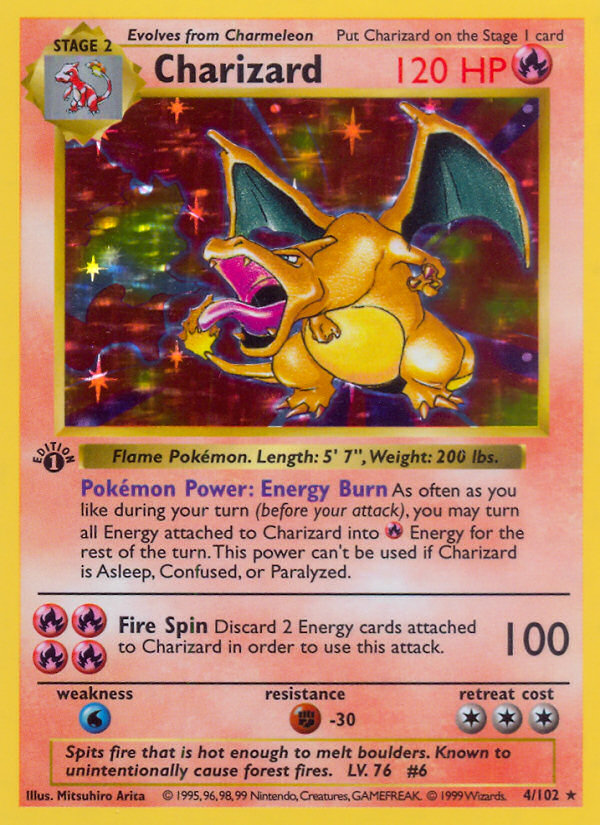
Charizard is card 4 of 102 in the original Base Set, released in English on January 9, 1999, with artwork by Mitsuhiro Arita. It was one of sixteen Rare Holos in the set, and the only starter final drawn in a fire pose that wraps the holofoil window. That framing is part of why it took over the hobby: the holo catches the eye at the exact moment a pack is opened.
The three variants, and why they matter so much
Base Set printed in three waves, and the same Charizard can be worth $300 or six figures depending on which one you hold. 1st Edition carries a small Edition 1 stamp under the lower left of the artwork. Shadowless has no stamp and no drop shadow on the right edge of the frame. Unlimited restored the drop shadow and ran for years. The fastest check is the drop shadow, visible even through a sleeve under bad lighting.
In price terms, the gap is the widest of any card in the hobby. A 1st Edition PSA 10 trades in the six figures, Shadowless in the five figures, and Unlimited in the mid four figures. The reason is population, not artwork: the 1st Edition PSA 10 count sits under 130 worldwide against thousands of PSA 9s. Confirm the variant before you discuss price, because a mislabeled Unlimited sold as Shadowless is the most common way buyers overpay.

The starter trio
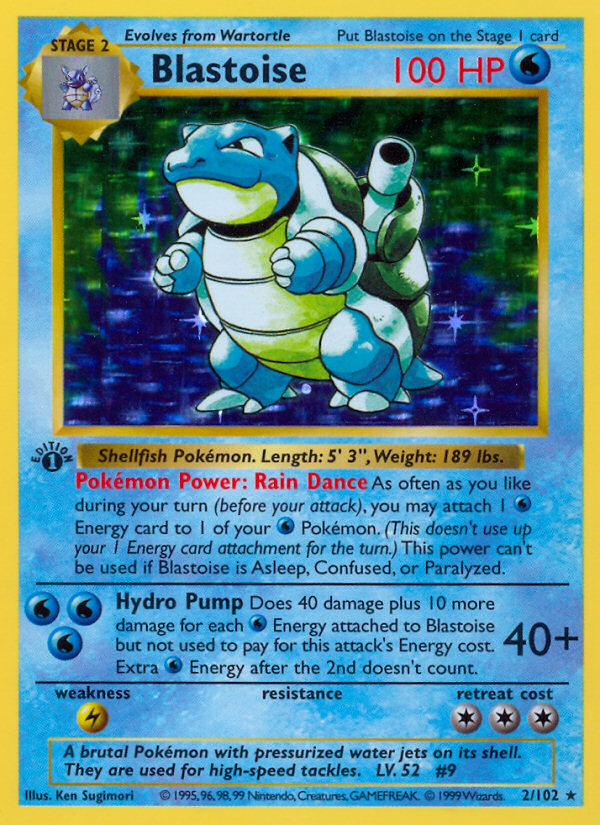
Charizard leads a trio. Blastoise (card 2) and Venusaur (card 15) complete the original holo starters, and both trail Charizard in price the way they always have, even though they share the same era, the same cardstock, and the same scarcity pressures. For a collector, the trio is the natural Base Set project, and Charizard is the slot that defines its cost.
Grading and condition
The holo window is where most grade points are won or lost. Surface scratches and print misregistration on the foil are common, and Wizards-era centering was inconsistent enough that PSA 10s remain scarce a quarter century later. Hold the card at 45 degrees under a strong light and rotate it slowly; any hairline in the holo will catch the light. Centering on the left and right borders is the second grade-killer.
If you are buying
Work in one order: variant, then grade, then comp. Confirm the print first, because a 1st Edition and an Unlimited are different markets for the same image. Inspect the holo and corners next, since condition holds most of the value. Then price against recent sales for that exact variant and grade, not a blended average. For any raw copy above a few hundred dollars, insist on angled-light photos of the holo before sending money.
Common questions
- How much is a Base Set Charizard worth?
- It depends entirely on the print variant and grade. A 1st Edition PSA 10 trades in the six figures, Shadowless in the five figures, and Unlimited in the mid four figures. Raw near-mint copies trade for hundreds to low thousands depending on variant.
- How do I tell which Base Set Charizard I have?
- Check the lower left of the artwork for an Edition 1 stamp (1st Edition), then the right edge of the frame for a drop shadow. No stamp and no drop shadow means Shadowless. No stamp with a drop shadow means Unlimited.
- Why is the 1st Edition Charizard so much more valuable?
- Population. The 1st Edition print ran for only about two months in early 1999, so the PSA 10 count sits under 130 against thousands of PSA 9s and far larger Unlimited numbers. That scarcity at the top grade drives the widest price spread in the hobby.